
Driverless Taxis in London: What Happens When the Car Takes Control?
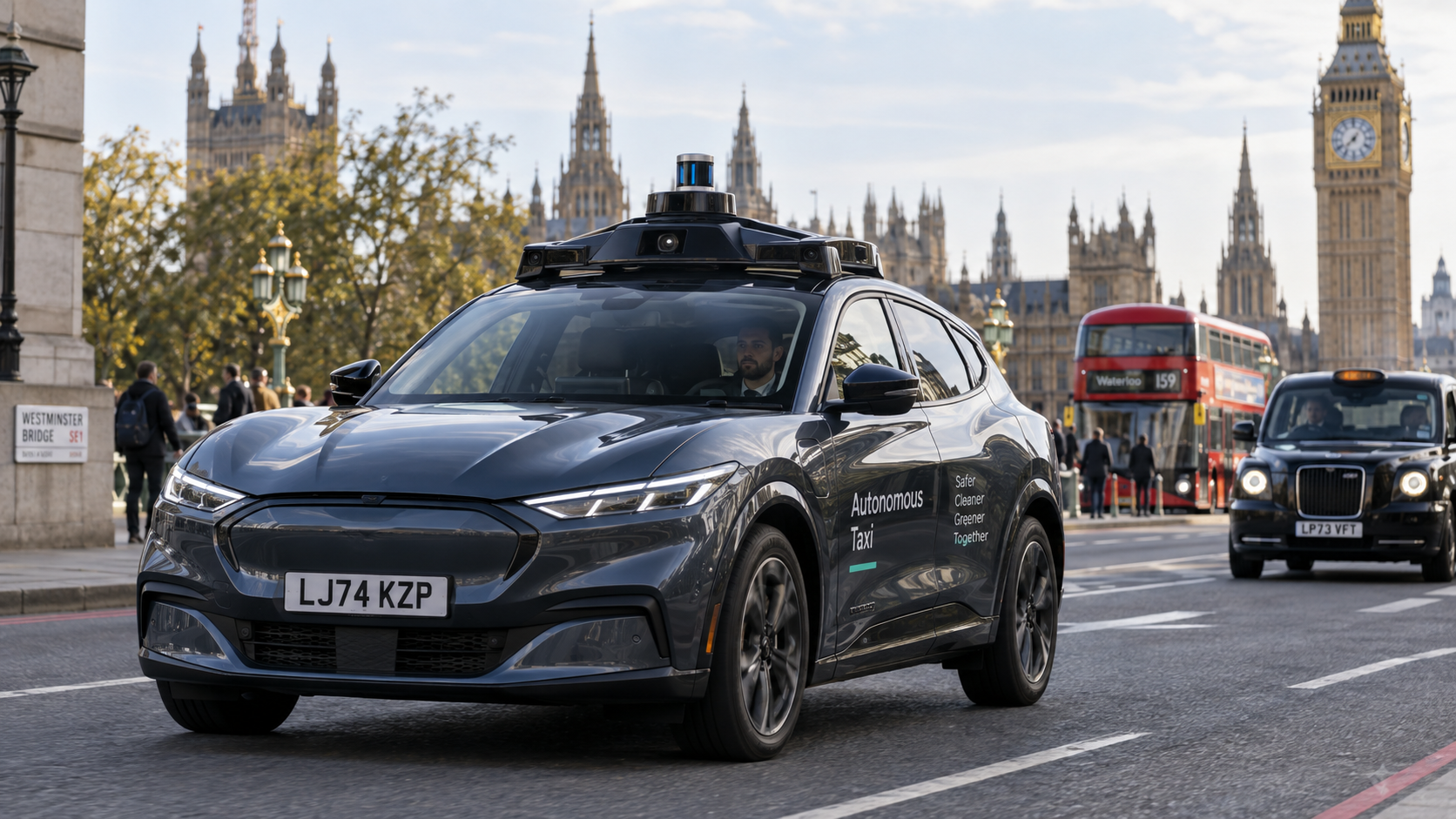
Imagine booking a taxi in London, climbing into the back seat and discovering that the car is doing the driving.
It sounds rather futuristic, but it's now becoming a reality.
On 3 September 2026, Uber and British autonomous vehicle company Wayve launched supervised autonomous rides in London.
The service uses electric Ford Mustang Mach-E vehicles fitted with Wayve's automated driving system and surrounding sensors.
Passengers booking UberX, Uber Electric or Uber Comfort may be matched with one of these vehicles at no additional cost. They can accept the autonomous ride or choose a conventional Uber instead.
There's an important distinction, however.
These aren't completely driverless taxis. Every journey has a trained, Transport for London-licensed private hire driver behind the wheel, supervising the technology and ready to intervene if necessary.
The current service is therefore an early step towards fully driverless transport rather than the finished article.
Nevertheless, it raises some fascinating questions.
Could autonomous vehicles make our roads safer? Who would be responsible if one caused an accident? And what happens to motor insurance when the person in the driving seat is no longer doing the driving?
At Peter Best Insurance Services, we arrange insurance for a wide range of vehicles, including classic and specialist cars. As automotive technology develops, the way insurers understand and assess vehicle risks will inevitably need to evolve.
Let's explore what London's autonomous taxis could mean for motorists and the future of insurance.
Why is London a challenging environment for autonomous vehicles?
London isn't exactly short of complicated driving situations.
There are busy junctions, narrow streets, cyclists, pedestrians, delivery vehicles, roadworks and motorists who occasionally seem to regard road markings as suggestions rather than instructions.
For an autonomous vehicle, navigating these situations involves much more than following a predetermined route.
The technology must recognise other road users, anticipate potential hazards and respond appropriately, often within a fraction of a second.
Wayve has been developing and testing its technology in London since 2018.
The company uses an artificial intelligence-based approach designed to learn from driving experience rather than relying entirely on detailed maps or individually programmed instructions for every possible situation.
The aim is to develop technology capable of adapting to different roads and driving environments.
London provides plenty of opportunities to test that ambition.
What could autonomous taxis mean for passengers?
The potential benefits go beyond the novelty of a car that drives itself.
Automated taxis could eventually provide greater freedom for people who cannot drive, including some older and disabled passengers.
They might also offer an alternative to owning a car, particularly in cities where parking is limited and running a vehicle can be expensive.
For people who currently depend on others for transport, greater access to reliable services could make a meaningful difference.
However, the benefits will depend on the technology's reliability, the accessibility and affordability of the services, and whether passengers feel confident using them.
Completing thousands of journeys successfully is one thing.
Understanding what happens when something goes wrong is another.
And that's where insurance becomes particularly interesting.
Could autonomous vehicles make driving safer?
Potentially, although it's too early to conclude that every autonomous driving system is safer than a human driver.
Different technologies operate in different locations and under different conditions.
Evidence from a system operating on relatively wide American roads, for example, cannot simply be applied to narrow British streets in heavy rain.
There is nevertheless a compelling reason to investigate the potential safety benefits.
Government analysis found that human error was recorded as a contributing factor in 88% of road collisions in Great Britain in 2020.
Automated driving could potentially reduce certain risks associated with tiredness, distraction and impaired driving.
A computer doesn't become impatient in traffic, decide to check its phone or attempt to drive after drinking.
Of course, that doesn't mean the technology cannot make mistakes.
Autonomous vehicles face different challenges.
Sensors can be affected by poor visibility and adverse weather. Software can misinterpret unusual situations. Digital systems can fail or become targets for cyberattacks.
Vehicles must also interact with human drivers, whose decisions aren't always predictable.
What safety standards must driverless cars meet?
The Automated Vehicles Act 2024 establishes a framework for authorising and regulating self-driving vehicles in Great Britain.
The legislation requires safety principles designed to ensure that authorised automated vehicles achieve a level of safety equivalent to, or higher than, careful and competent human drivers.
The principles must also aim to ensure that road safety in Great Britain improves as a result of introducing authorised automated vehicles.
This establishes a demanding objective.
However, the real challenge is demonstrating that individual systems meet the required standard across different roads, weather conditions and traffic situations.
Reliable evidence from testing and real-world operation will be essential.
Manufacturers, regulators and insurers will all need to understand how particular technologies perform, including their limitations.
For motorists, confidence will depend on more than knowing that a vehicle can drive itself.
They'll want to know that it can do so safely and that clear arrangements exist if something goes wrong.
Who is responsible when an autonomous vehicle causes an accident?
With a conventional vehicle, determining responsibility often involves examining the actions of the drivers.
Was someone speeding? Did they fail to give way? Were they distracted?
But when software is performing the driving task, the investigation could look rather different.
An accident might involve a sensor malfunction, a software error, inadequate maintenance or another road user's actions.
Several organisations could be involved in developing, maintaining and operating the technology.
For someone injured in a collision, establishing which organisation was responsible could otherwise become a complicated process.
What does UK legislation say?
The Automated and Electric Vehicles Act 2018 began addressing this issue.
Where a listed automated vehicle is insured, is driving itself and causes an accident on a road or other public place in Great Britain, the Act makes the motor insurer liable in the first instance for the resulting damage, subject to the statutory requirements.
The Act also contains specific owner-liability provisions for certain vehicles that are legally exempt from compulsory insurance. These do not automatically make every owner of an uninsured automated vehicle liable under the Act.
The framework provides a route to compensation without requiring an injured person to establish immediately whether the fault originated with the vehicle's software, sensors, manufacturer or another organisation.
The insurer can investigate whether another party should ultimately bear some or all of the cost.
This distinction is important.
Someone injured in a road accident shouldn't have to resolve a technical dispute between a manufacturer, software developer and fleet operator before beginning a compensation claim.
There are, however, qualifications.
Compensation may be reduced if an injured person contributed to the accident.
The legislation also contains provisions relating to prohibited software alterations and failures to install safety-critical updates. Depending on the circumstances, these can affect liability and the insurer's rights.
The precise outcome will depend on the facts of the accident and the applicable legislation.
What changes when there's nobody in the driving seat?
London's current Uber and Wayve vehicles still have supervising drivers.
Future services, however, could involve vehicles travelling without anyone responsible for driving sitting behind the wheel.
The Automated Vehicles Act 2024 establishes a wider legal framework for these vehicles.
It creates a distinction between responsibility for the automated driving technology and responsibility for the vehicle's operation.
Several new roles are particularly important.
The authorised self-driving entity
Every authorised automated vehicle will need an authorised self-driving entity, commonly known as an ASDE.
This will usually be the manufacturer or developer responsible for the automated driving system.
The organisation will be responsible for ensuring that the vehicle continues to meet the required self-driving standards and complies with relevant regulatory obligations.
In other words, the company responsible for the technology will have ongoing responsibilities for its performance.
The no-user-in-charge operator
Some automated vehicles will be authorised to complete entire journeys without anyone needing to take control.
These vehicles will require a licensed no-user-in-charge operator.
This organisation will oversee non-driving responsibilities, including vehicle roadworthiness, maintenance and responding to breakdowns or incidents.
The business responsible for developing the driving technology and the organisation operating the vehicle might be separate companies.
That distinction will become important when determining responsibility for different aspects of a vehicle's operation.
What about the person travelling inside?
For authorised automated vehicles that may require someone to resume control during a journey, the legislation introduces the role of a user-in-charge.
When an authorised self-driving feature is engaged and operating within its approved conditions, that person will generally not be responsible for offences arising solely from the way the vehicle drives.
However, they will retain responsibilities outside the automated driving task.
They may also need to respond appropriately if the vehicle issues a valid request to resume control.
If the system asks the person to take over, there will be a defined transition period during which control must be resumed.
This differs considerably from the driver-assistance systems fitted to many conventional cars.
When will the new rules take effect?
Much of the regulatory framework is still being developed.
The Government is preparing the secondary legislation and detailed safety requirements needed to implement the Automated Vehicles Act 2024.
Full implementation is currently intended for the second half of 2027.
Until then, supervised autonomous services such as the Uber and Wayve launch represent an intermediate stage in the development of driverless transport.
How could autonomous driving change motor insurance?
Insurance will remain important because motorists, passengers and other road users need protection when accidents happen.
However, the risks involved could become very different from those associated with conventional vehicles.
Rather than investigating only the actions of a driver, insurers may need to consider the vehicle's software, operating conditions, maintenance and the organisations responsible for its automated functions.
This could change several aspects of motor insurance.
1. Accident investigations could require much more vehicle data
Imagine two visually identical vehicles involved in separate collisions.
One was being driven manually. The other was operating with an authorised self-driving feature engaged.
That distinction could be central to establishing responsibility.
Insurers may need access to information that helps answer questions such as:
Was the automated driving system active when the collision occurred?
Was the vehicle operating on an authorised road and within its permitted speed and weather conditions?
Did the system request that a human resume control?
Was sufficient warning provided?
Had the required software and security updates been installed?
Was there a mechanical problem, damaged sensor or cybersecurity incident?
This information could help determine whether an accident resulted from the vehicle's automated driving system, a maintenance issue, human actions or another factor.
However, accessing the information may not always be straightforward.
Insurers, manufacturers, software developers and operators will need reliable and appropriately standardised data.
Without it, apparently straightforward claims could become lengthy technical disputes.
Access must also respect privacy and protect commercially sensitive information.
The challenge will be ensuring that the information required to investigate a claim is available without creating unnecessary risks for vehicle owners and passengers.
2. Vehicle repairs could become more complicated
Modern vehicles already contain cameras, radar and other sensors that make some repairs considerably more involved than they once were.
Autonomous vehicles could increase that complexity.
A seemingly minor collision might damage equipment responsible for identifying pedestrians, other vehicles or road markings.
Replacing a bumper or repairing a body panel may not be sufficient.
The sensors and associated systems could require specialist inspection, recalibration and testing before the vehicle is safe to return to the road.
A repaired vehicle needs to do more than look right.
Its technology must still interpret the surrounding environment correctly.
These requirements could affect repair costs, repair times and the availability of suitably equipped repairers.
For insurers, fewer accidents wouldn't necessarily mean proportionately lower claims costs if individual repairs became more expensive.
3. Insurance pricing may need to reflect different risks
Traditional motor insurance considers information such as a driver's age, experience, claims history, vehicle and location.
For vehicles operating fully autonomously, some of those factors may become less relevant while the automated system is performing the driving task.
Insurers may increasingly need to consider the vehicle's software, its operating environment, maintenance and update history, and the organisations responsible for its operation.
Two outwardly similar vehicles could present very different risks because they use different automated driving systems or have different authorised capabilities.
The information needed to arrange suitable insurance may therefore become more detailed.
For insurance brokers, accurately identifying a vehicle's specification and how it is used will remain important.
4. Software and cybersecurity introduce additional considerations
Conventional vehicles can suffer mechanical and electrical failures.
Automated vehicles introduce further risks involving software reliability, digital security and connected systems.
A defect in a widely used software platform could potentially affect many vehicles rather than a single car.
Cybersecurity incidents might also involve vehicle operation, disruption to services or access to sensitive information.
Insurers will need to understand how these risks are managed and how responsibility is allocated when something goes wrong.
Manufacturers and developers will also have ongoing responsibilities for maintaining the safety and security of their systems.
Driver assistance isn't the same as self-driving
This is an important distinction for motorists.
Many modern vehicles already have features such as adaptive cruise control, lane-keeping assistance and automatic emergency braking.
However, having these systems doesn't mean a car is legally authorised to drive itself.
Most conventional driver-assistance features require the driver to remain attentive and responsible throughout the journey.
An authorised self-driving system operates under a different legal framework and within specified conditions.
Where a vehicle is authorised to operate with a user-in-charge, the legal responsibilities also differ while the approved self-driving feature is engaged.
Confusing assistance with automation could create dangerous situations.
Drivers need to understand exactly what their vehicle can do, what it cannot do and when they remain responsible for controlling it.
These distinctions could also become important when investigating an insurance claim.
Will driverless technology make motor insurance cheaper?
It's a question many motorists will understandably want answered.
Well... possibly.
But it's too early to assume that autonomous vehicles will automatically lead to lower premiums.
If automated driving reduces the number of collisions, that could reduce some insurance costs.
However, the frequency of accidents is only one part of the calculation.
Autonomous vehicles may contain expensive sensors and computing systems that require specialist repairs and calibration.
Even relatively minor damage could result in a substantial repair bill.
A software defect could also potentially affect a large number of vehicles using the same technology.
Insurers will need to balance any reduction in collision frequency against repair costs, claim severity and new technology-related risks.
The answer will ultimately depend on real-world claims evidence.
Insurers will want to understand how often particular automated systems are involved in accidents, the severity of those incidents and the costs associated with repairing the vehicles.
Until sufficient comparable evidence becomes available, it's too early to establish how autonomous driving will affect premiums across the wider motor insurance market.
What Does the Future Hold for Motor Insurance?
The arrival of supervised autonomous taxis in London marks an important development in the way vehicles are operated.
It also demonstrates why the transition to fully driverless transport is likely to be gradual.
For now, Uber and Wayve's vehicles still have a licensed driver ready to intervene.
The wider regulatory framework is being completed, and questions surrounding vehicle data, repairs, cybersecurity and responsibility will continue to develop.
For insurers and brokers, the focus may increasingly shift from assessing how an individual drives to understanding how an entire transport system operates.
That includes the vehicle, its software, the organisations responsible for automated driving and those responsible for keeping it on the road.
Britain's busy and sometimes unpredictable roads will provide a demanding environment in which to establish how well the technology performs.
If autonomous vehicles can deliver improvements in safety and accessibility, they could change how people travel.
However, one important principle remains.
Whatever technology is doing the driving, people involved in an accident need to understand who is responsible and how they can obtain compensation.
Motoring Is Evolving. Is Your Insurance Up to Date?
From classic cars to modern vehicles with increasingly advanced technology, having suitable motor insurance remains important. Explore the specialist car insurance options available through Peter Best Insurance Services and get a quote today.


