
Everyday Driving Mistakes That Can Cost You Points (and Pounds)
10 Overlooked Driving Rules That Could Result in Fines, Penalty Points or Higher Insurance Costs
Whether you're taking your everyday car to the shops, heading out for a weekend drive in your classic or travelling to a motoring event, it's worth knowing the rules that could catch you out.
Most motorists wouldn't dream of deliberately breaking the law. But not every driving offence involves speeding or dangerous driving. Sometimes, an overlooked detail, an incorrectly displayed number plate or an unsafe load can lead to an unexpected penalty.
And although some offences result in a fine alone, others can leave you with points on your licence, a driving conviction or even a disqualification. Depending on the offence and your circumstances, this could also affect your insurance premium.
We've picked out ten driving mistakes that are worth keeping in mind, along with the penalties and some practical advice to help you avoid them.
1. Packing Too Much Into Your Vehicle
Potential penalty: £100–£300 fixed penalty, with prosecution possible for more serious offences.
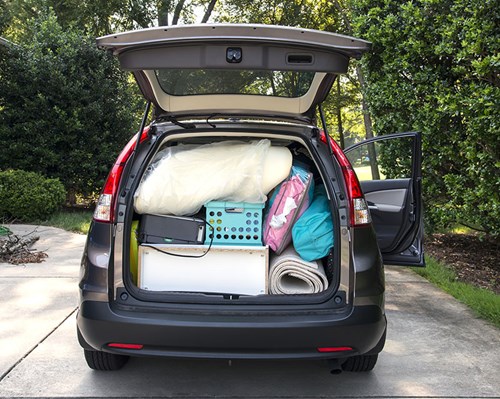
It's tempting to squeeze everything into one trip, whether you're collecting a large purchase, clearing the garage or packing for a weekend away.
However, every vehicle has a maximum permitted weight, known as its Maximum Authorised Mass (MAM) or gross vehicle weight.
This includes the weight of the vehicle, passengers, fuel, luggage and anything else being carried. Individual axle weight limits must also be observed.
Driving an overloaded vehicle can affect braking and handling, particularly when negotiating corners or travelling at higher speeds.
The Driver and Vehicle Standards Agency (DVSA) can issue graduated fixed penalties according to how much a vehicle exceeds its permitted weight:
Less than 10% overweight: £100
10% to less than 15% overweight: £200
15% or more overweight: £300
DVSA normally allows a 5% enforcement tolerance before issuing a penalty or prohibition, unless the excess weight is one tonne or more. This isn't an allowance to exceed the legal limit.
Serious overloading can lead to court proceedings, and you may be prohibited from continuing your journey until the excess weight has been removed.
Before you set off: Check your vehicle's weight plate or handbook, particularly if you're carrying tools, spare parts or equipment for a motoring event. Older vehicles may have lower load limits than modern equivalents.
2. Travelling With an Insecure Load
Potential penalty: A fine, penalty points or prosecution, depending on the offence and circumstances.
A toolbox sliding around in the boot might seem harmless until you have to brake suddenly.
The same goes for luggage piled on the back seat, spare wheels being transported to a garage or equipment attached to a roof rack.
Under Highway Code Rule 98, drivers must secure their loads and ensure nothing projects dangerously from the vehicle.
Even when you're travelling a short distance, unsecured items can move unexpectedly or, in more serious cases, fall onto the road.
There's no single automatic penalty for every insecure load. The action taken depends on the circumstances and whether the vehicle is being used in a dangerous condition or another driving offence has occurred.
Before you set off: Secure heavy items, distribute weight carefully and check that roof-mounted equipment and external carriers are properly fastened. If you're transporting car parts, make sure they can't move during sudden braking.
3. Driving With an Obstructed View
Potential penalty: Up to £1,000 and three penalty points for failing to maintain proper control or a full view of the road and traffic ahead.
Some drivers assume it's illegal to travel with anything blocking the rear window. But the rules aren't quite that straightforward.
A number of vehicles, including many vans, are manufactured without a usable rear window.
The important considerations are whether your vehicle has the legally required mirrors and whether you can see sufficiently to drive safely.
However, anything that prevents you from maintaining a proper view of the road ahead or controlling the vehicle can result in penalties.
That might include a poorly positioned sat nav, something hanging in front of the windscreen or items stacked where they interfere with your forward visibility.
For classic car owners, it's also worth paying attention to the condition and adjustment of mirrors, particularly on vehicles with smaller windows or less effective rearward visibility than modern cars.
Before you set off: Check that your windscreen is clear, your mirrors are correctly adjusted and nothing interferes with your view. If the rear window is obscured, take extra care when reversing or changing lanes.
4. Driving on Worn or Damaged Tyres
Potential penalty: Up to £2,500 and three penalty points per illegal tyre on a car.
When you're looking after a classic or enthusiast vehicle, maintaining tyres involves more than checking whether there's enough tread left.
Tyres can deteriorate with age, particularly on vehicles that spend long periods in storage or cover relatively few miles.
For cars and light vans, the legal minimum tread depth is 1.6mm across the central three-quarters of the tyre and around its entire circumference.
Driving with tyres below the legal limit could lead to a fine of up to £2,500 and three penalty points for each illegal tyre.
If all four tyres fail to meet the legal requirements, the penalties could potentially total £10,000 and twelve points.
But tread depth isn't the only consideration. Cracking, bulges, cuts and other damage can make a tyre unsafe even when there's plenty of tread remaining.
A reminder for classic car owners: Some historic vehicles qualify for MOT exemption, but that doesn't remove the obligation to keep them roadworthy.
Before you set off: Examine tyres carefully if your vehicle hasn't been used for a while. Check their condition and pressure as well as tread depth, and seek professional advice if there's evidence of ageing or deterioration.
5. Getting the Seatbelt Rules Wrong
Potential penalty: Up to £500 for relevant seatbelt offences.
For most drivers, fastening a seatbelt is second nature. But if you own an older vehicle, the rules can be a little less familiar.
In general, drivers and passengers must wear a seatbelt where one is fitted, unless a legal exemption applies.
Passengers aged 14 and over are normally responsible for wearing their own seatbelts. Drivers are responsible for ensuring that children under 14 are using the appropriate restraint.
Children usually need a suitable car seat until they reach 135cm in height or their 12th birthday, whichever comes first.
However, special rules apply to classic vehicles that were originally manufactured without seatbelts.
If your vehicle was originally made without seatbelts, adults can travel without them, but:
Children under three must not travel in the vehicle.
Children aged three and over may only travel in the rear seats.
These exceptions shouldn't be confused with simply removing seatbelts from a vehicle that was originally fitted with them.
Failure to follow the applicable seatbelt or child restraint requirements can result in a fine of up to £500.
Before you set off: If you own a classic car, check the rules that apply to its original specification. If seatbelts are fitted, ensure they're in good condition and used where legally required.
6. Checking Your Phone at Traffic Lights
Potential penalty: £200 fixed penalty and six points, or a court fine of up to £1,000 (£2,500 for lorry and bus drivers).
You're waiting at a red light, your phone vibrates and you decide to check who's calling.
It might take only a moment, but that moment could result in six penalty points.
The law prohibits holding and using a mobile phone or another device capable of sending or receiving data while driving, including when the vehicle is stationary in traffic.
This applies to activities such as reading messages, changing music, taking photographs or checking directions.
It also applies if you're queuing in traffic or your vehicle's stop-start system has temporarily switched off the engine.
There are limited exceptions, including contacting emergency services when it's unsafe or impractical to stop, making a contactless payment while stationary or using an approved remote-parking function.
Hands-free systems are permitted, provided you remain in proper control of the vehicle and aren't distracted.
Before you set off: Enter your destination, choose your music and put your phone somewhere you won't be tempted to pick it up. If you need to use it, park safely first.
7. Forgetting to Update Your Driving Licence
Potential penalty: Up to £1,000 for failing to update your address.
Moving house often means updating dozens of accounts and documents. Your driving licence can easily slip down the list.
However, you must tell the Driver and Vehicle Licensing Agency (DVLA) when your address changes.
Failing to update your details could result in a fine of up to £1,000.
You'll also need to update your vehicle's V5C registration certificate separately, where applicable.
If you own more than one vehicle, remember that each registration document needs to reflect the correct keeper details.
It's worth checking your driving licence photocard expiry date too. Photocards generally need renewing every ten years, although the expiry of the card and your underlying legal entitlement to drive are separate matters.
Before you set off: If you've recently moved, check your driving licence, V5C documents and insurance details. Your driving licence address can be updated online free of charge.
8. Assuming Pavement Parking Is Allowed
Potential penalty: A parking penalty or other enforcement action, depending on the location and circumstances.
Parking can be difficult on narrow streets, particularly when you're trying to avoid leaving your vehicle vulnerable to passing traffic.
You might think putting two wheels on the pavement is the considerate option, but it's important to check the local rules.
In London, pavement parking is generally prohibited unless an exception or exemption applies.
Scotland also has a general pavement-parking prohibition, with certain exemptions. Scottish local authorities can issue a £100 penalty, reduced to £50 if paid within 14 days.
Elsewhere in England and Wales, the rules differ. Restrictions may apply to particular streets, and obstructing a pavement can still result in enforcement action.
There has also been a change to the legislation in England.
The English Devolution and Community Empowerment Act 2026 introduced powers allowing regulations that would enable English local transport authorities to prohibit pavement and verge parking in their areas.
This doesn't mean that pavement parking has automatically become illegal everywhere in England. The new framework allows for further restrictions to be introduced through the relevant processes.
Before you leave your vehicle: Check local signs and restrictions. Avoid parking where your car could obstruct pedestrians, wheelchair users or pushchairs.
9. Accumulating Six Penalty Points as a New Driver
Potential consequence: Driving licence revoked.
For newly qualified motorists, penalty points can have much greater consequences than they might expect.
Under the Road Traffic (New Drivers) Act 1995, drivers who accumulate six or more penalty points within two years of passing their first practical driving test will have their licence revoked.
A single offence carrying six points, such as using a handheld mobile phone while driving, can therefore be enough to lose your full licence.
Points received while driving on a provisional licence can also count if they're still valid when you pass your test.
If your full licence is revoked under these rules, you'll need to apply for a new provisional licence and pass both your theory and practical tests again.
For young drivers who have recently bought their first classic or modern classic car, this makes understanding the rules particularly important.
Before you set off: Remember that the first two years after passing your test come with stricter consequences for accumulating points. An offence that might not lead to immediate disqualification for an experienced driver could mean starting the test process again.
10. Displaying an Incorrect or Unreadable Number Plate
Potential penalty: Up to £1,000.
Number plates might be a small part of your vehicle, but they play an important role in identification and road enforcement.
Whether your registration is obscured by dirt, the characters are incorrectly spaced or the plate doesn't meet the required standards, you could find yourself facing a penalty.
Government guidance states that incorrectly displayed registration plates can result in a fine of up to £1,000 and an MOT failure.
Personalised registrations are subject to strict requirements, including the size, style and spacing of letters and numbers. You can't rearrange characters to make a registration resemble a word or name.
But what about classic cars with traditional black and silver number plates?
Some historic vehicles are permitted to display these older-style plates rather than the modern white and yellow reflective versions.
The current rules generally allow vehicles manufactured before 1 January 1980 to display traditional black and silver plates, provided they meet the relevant requirements, including historic vehicle tax-class eligibility.
Vehicles manufactured from 1 January 1980 onwards generally need to follow the modern plate requirements.
Before you set off: Check that your registration is clearly visible, particularly after driving in poor weather. If you're fitting traditional plates to a classic car, make sure your vehicle qualifies rather than assuming the rules apply to every vehicle over 40 years old.
Could Driving Convictions Affect Your Classic Car Insurance?
A motoring offence can have consequences beyond the original fine.
When assessing an application for insurance, an insurer may consider the driver's history, including relevant motoring convictions and penalty points.
Depending on the offence, this could affect the premium, the terms offered or whether an insurer is willing to provide cover.
However, not every offence carries penalty points, and there's no single rule governing how much a conviction will increase your insurance premium.
The outcome depends on several factors, including the offence itself, the driver's circumstances and the insurer's underwriting criteria.
Do You Have to Declare Penalty Points or Driving Convictions?
When taking out or renewing motor insurance, you should answer all questions about your driving history accurately.
If you receive penalty points or a conviction during the policy period, check your insurance documents to establish whether your insurer requires immediate notification or whether the information needs to be provided at renewal.
Some driving endorsements remain on your DVLA record for four years, while others remain for eleven years. Insurers may ask about convictions over a particular period, so it's important to answer the questions asked rather than relying solely on whether an endorsement still appears on your licence.
For classic and specialist vehicle owners, it's also important to keep other relevant policy information accurate, including details of drivers, vehicle modifications and how the vehicle is used.
Enjoy the Drive, Without an Unwelcome Surprise
Owning and driving a car should be enjoyable, whether it's your daily transport, a cherished classic or a vehicle reserved for special occasions.
A few routine checks before leaving home can help avoid unnecessary problems, from ensuring your tyres are roadworthy to checking that luggage is securely stowed and your registration plates are clearly visible.
And if you drive a classic car, it's worth remembering that certain exemptions may apply to older vehicles, but they don't remove your responsibilities for road safety.
Staying informed about the rules could help you avoid penalties, protect your driving record and prevent unnecessary complications with your insurance.
Looking for classic car insurance?
At Peter Best Insurance Services, we understand that classic and specialist vehicles can have different insurance requirements from everyday cars. Explore our classic car insurance options and find out more about the cover available for your vehicle.
Frequently Asked Questions About Driving Fines and Classic Cars
Can you get penalty points for an insecure load?
Potentially, but it depends on the offence and circumstances. An insecure load doesn't automatically result in three points. More serious situations, particularly where a vehicle is used in a dangerous condition, can lead to penalty points or prosecution.
Are classic cars exempt from seatbelt laws?
Some classic vehicles originally manufactured without seatbelts can legally be used without them, subject to the applicable rules. However, if seatbelts are fitted, they generally must be worn where required. Special restrictions also apply when carrying children in vehicles originally made without seatbelts.
Can classic cars use black and silver number plates?
Yes, but only where the vehicle meets the relevant requirements. Vehicles manufactured before 1 January 1980 may qualify for traditional black and silver plates, subject to the applicable DVLA rules and historic tax-class requirements. Being more than 40 years old doesn't automatically mean a vehicle can display them.
Does a classic car need legal tyre tread if it's MOT-exempt?
Yes. MOT exemption doesn't remove the requirement to keep a vehicle roadworthy. Tyres must meet the legal requirements for the vehicle and be safe to use.
Is it illegal to drive when you can't see through your rear window?
Not automatically. Vehicles must meet the relevant mirror requirements, and the driver must have sufficient visibility to operate safely. However, obstructing your view of the road ahead or compromising control can lead to penalties.
Do penalty points increase classic car insurance premiums?
They can. Insurers may consider convictions and penalty points when assessing an application, but the impact varies depending on the offence, driver and insurer.
How long do driving convictions stay on your licence?
Endorsements generally remain on your DVLA driving record for four or eleven years, depending on the offence. However, insurers may ask for information about convictions over a particular period, which may differ from how long the endorsement remains on your record.
Can you drive a classic car without an MOT?
Some historic vehicles are exempt from MOT testing, depending on their age and whether substantial changes have been made. However, exemption doesn't mean the vehicle can be driven in an unsafe or unroadworthy condition.
Sources and Further Reading
The information in this article is based on official UK Government guidance, the Highway Code and relevant road traffic legislation.
For more detailed information about the rules and penalties, visit:
The Highway Code – https://www.gov.uk/guidance/the-highway-code
DVSA – Roadside checks, fines and financial deposits - https://www.gov.uk/government/publications/guide-to-graduated-fixed-penalties-financial-deposits/dvsa-roadside-checks-fines-and-financial-deposits
Highway Code – Rules for drivers and motorcyclists, including loading requirements - https://www.gov.uk/guidance/the-highway-code/rules-for-drivers-and-motorcyclists-89-to-102
Highway Code – Annex 5: Driving penalties - https://www.gov.uk/guidance/the-highway-code/annex-5-penalties
Highway Code – Annex 6: Vehicle maintenance and tyre safety - https://www.gov.uk/guidance/the-highway-code/annex-6-vehicle-maintenance-safety-and-security
Seatbelt laws - https://www.gov.uk/seat-belts-law
Mobile phone use while driving - https://www.gov.uk/using-mobile-phones-when-driving-the-law
DVLA – Change your driving licence address - https://www.gov.uk/change-address-driving-licence
Highway Code – Waiting and parking rules - https://www.gov.uk/guidance/the-highway-code/waiting-and-parking-238-to-252
English Devolution and Community Empowerment Act 2026 - https://www.legislation.gov.uk/ukpga/2026/23/contents
DVLA – New driver penalty-point rules - https://www.gov.uk/penalty-points-endorsements/new-drivers
DVLA – Number plate requirements - https://www.gov.uk/displaying-number-plates
DVLA – How long driving endorsements remain on your record - https://www.gov.uk/penalty-points-endorsements/how-long-endorsements-stay-on-your-driving-licence
This article is intended as general information only and does not constitute legal advice.
Information reviewed October 2026. Driving rules, penalties and enforcement arrangements can vary according to the offence, circumstances and location. The information above primarily concerns Great Britain; some rules and procedures differ in Northern Ireland. Always refer to current official guidance.


